Forces and Motion Vocabulary for Kids
Forces and Motion Vocabulary for Kids: Words and Activities starts with a concrete idea: a force is a shove or pull that changes movement. Children see forces when a ball rolls, a swing slows, or a magnet draws a paper clip closer. This guide offers families practical words, sentence models, and activities for ages 4–15. Start with actions, then add terms for speed, direction, and each force.
Core Words to Teach First
When teaching Forces and Motion Vocabulary for Kids: Words and Activities, begin with actions a child can show: push, pull, lift, drop, roll, slide, spin, bounce, fall, start, stop, and turn. Send a toy car away, pull it back, and roll it across the floor. Each action demonstrates its word.
Next, add movement words: motion, speed, fast, slow, direction, straight, up, down, forward, and backward. Older children can use accelerate for speeding up and decelerate for slowing down. Force terms include gravity, friction, magnet, attract, and repel.
Putting the Words into Short Sentences
Teach one action with one result: “I nudge the car. It moves forward,” or “I pull the door. It opens.” A child can change one part: “I tap the ball. It rolls away.” These patterns combine grammar with the science idea.
Use questions to extend answers. Ask, “What made the ball move?” A younger child may answer, “My hand.” An older child can say, “The ball moved because my hand applied a force.” Then ask, “What made it stop?” Introduce friction: “The carpet slowed the ball down.”
Keep Forces and Motion Vocabulary for Kids: Words and Activities tied to visible events. “The leaf falls because gravity pulls it down” works better than an isolated definition. “The magnet attracts the paper clip” links the verb to an observable change.
Language tip: Model a full sentence after accepting a short answer. If your child says “push,” respond, “Yes, your hand made the car move forward.”
How Common Forces Change Motion
A force can start or stop an object, alter its speed, or change its direction. The table pairs each force with an effect children can test safely at home.
Compare one object on two surfaces. A toy car may travel farther on a smooth floor than on a folded towel. The same force creates different motion because each surface produces different friction. Record the observation without chasing the “right” result.
Motion myths to correct
Myth: A moving object always needs another force to keep moving.
Fact: An initial force can start the motion, while friction and other forces affect how the object continues or stops.
Myth: Friction is always a problem.
Fact: Friction helps shoes grip the ground and helps bicycle brakes slow a wheel.
Activities for Different Ages
The same Forces and Motion Vocabulary for Kids: Words and Activities can grow with your child. For school-age kids, use a soft ball and give one-step directions: “Roll it,” “Stop it,” or “Push it slowly.” Let the child copy the action and repeat the word. Keep each round brief and active.
For school-age kids, make a ramp with a book and firm cardboard. Roll the same toy from different points. Ask, “Which roll was faster?” and “What changed?” Children can record results using high, low, fast, slow, and far.
For school-age kids, ask learners to predict before testing. Compare surfaces, alter the ramp angle, or test how a stronger push changes speed and distance. Request complete explanations: “The car slowed sooner on the towel because there was more friction.” The goal is precise English supported by observed evidence.
Before each activity
- Choose objects that will not break or cause injury.
- Clear a safe path for rolling or sliding objects.
- Select four or five words to practise.
- Ask for a prediction before the test.
- Finish with one spoken sentence about the result.
Practice Routines and Common Mistakes
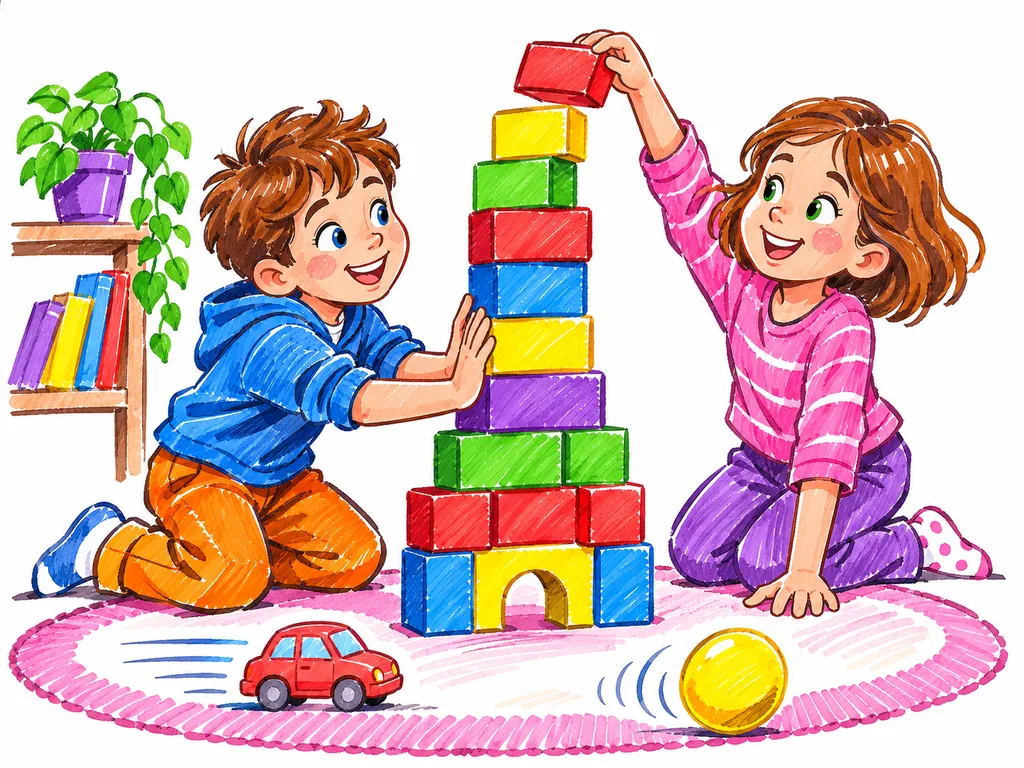
Use a three-step routine: act, describe, explain. First, your child acts. Next, they name it: “I pulled the box.” Finally, they explain the result: “The box moved towards me.” In LearnLink lessons, tutors use questions and visible examples to develop single words into connected explanations.
Try the Mystery Force Game
Cover the action with a book or cloth while you push, pull, tilt, or use a magnet on a safe object. Your child watches the motion and names the force: “I think a magnet pulled the object.” Reveal the action, then compare the guess and result.
Correct meaning before grammar. Children may call every movement a push or confuse fast with far. Demonstrate the difference: speed measures how quickly something moves; distance measures how far it travels. A ball can move fast for a short distance or slowly for a long distance.
Do not treat heavy as another word for slow. Weight, force, surface, and shape each affect observations. Explain that attract means move towards, while repel means move apart. Place two magnets together to show the contrast.
- Choose three household objects and name each push, pull, or motion.
- Sort six picture cards into push, pull, fast, slow, stop, and turn.
- Read one science page aloud and underline every force or motion word.
- Act out four verbs, then ask your child to describe each movement.
- Correct one mistake by modeling the sentence, then invite an immediate retry.
When a word has several meanings or pronunciations, Cambridge Dictionary is a useful check before turning it into child-friendly examples.
Frequently Asked Questions
At What Age Can Children Learn Forces and Motion Words?
You can use Forces and Motion Vocabulary for Kids: Words and Activities from age four when the language matches your child’s stage. Young learners can act out push, pull, roll, and stop. Older learners can explain gravity, friction, speed, and direction. The concepts remain; sentences and reasoning become more detailed.
How Many New Words Should We Practise at Once?
Begin with a small set for one activity. Four or five related words may suit a short session: push, roll, fast, slow, and stop. Reuse them for several days before adding more. Your child should understand each word, say it, and apply it to a new example.
Does My Child Need to Understand Science Before Learning These Words?
No. An action can introduce the English word and science idea together. A child needs no formal definition of friction before noticing that a car slows on a rough surface. Start with observation, add the term, then explain the link in a short sentence.
How Can Multilingual Families Practise This Vocabulary?
Use every language your family needs to explain the idea, but keep the target sentence in English. Your child might discuss a prediction in another home language, then report, “The ball rolled faster on the smooth floor.” This separates scientific understanding from English recall while building precise vocabulary.
Try this seven-minute routine today:
- Choose four related motion words.
- Test them with one safe object.
- Ask your child to say one complete sentence about the result.
Want to see how these ideas work in a real lesson — try a LearnLink trial lesson.
Stay updated on our latest tips and resources by following us on Instagram LearnLink.