States of Matter in English for Kids
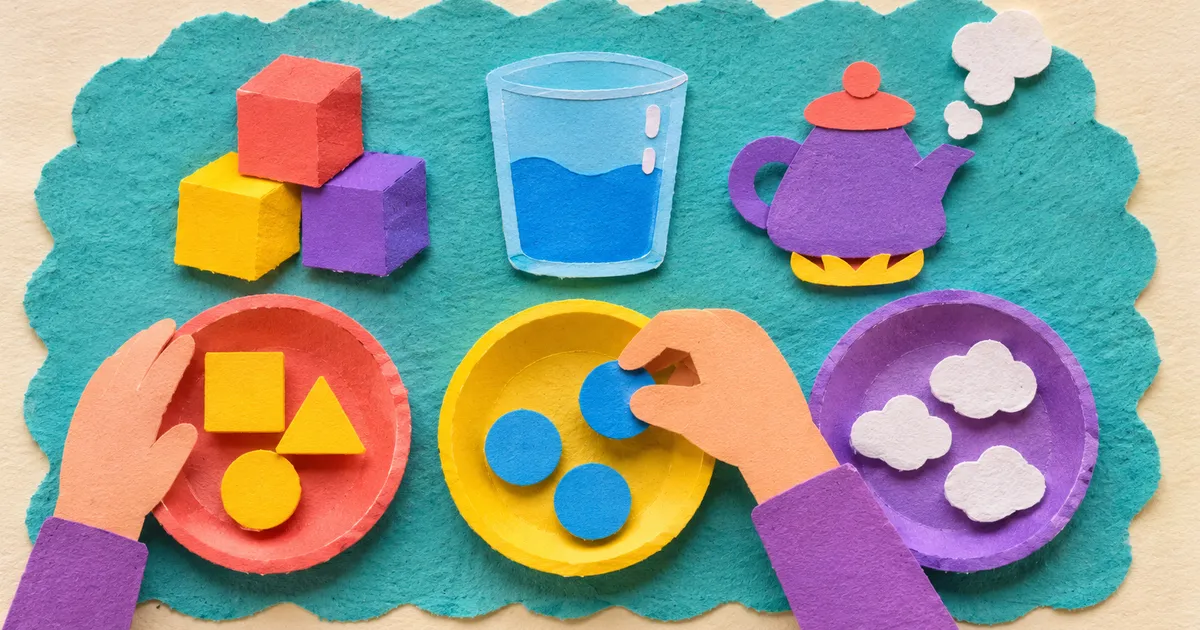
Matter has mass and takes up space; its three basic states are solid, liquid, and gas. States of Matter in English for Kids: Words and Activities teaches your child to name each state, describe its properties, and explain changes. Start with familiar examples: an ice cube, milk in a cup, and air inside a balloon. Children learn through models, sentence frames, and repeated speaking while they observe, sort, pour, freeze, and compare.
Core Words for the Three States
Teach matter, state, solid, liquid, and gas first. A solid keeps its shape and volume. A liquid keeps its volume but takes its container’s shape. A gas fills the available space. For younger children, “amount of space” is easier than “volume”; add the science term after they understand the idea.
Add the action words melt, freeze, evaporate, and condense. Their noun forms are melting, freezing, evaporation, and condensation. In States of Matter in English for Kids: Words and Activities, connect each word to an observable change instead of asking only for definitions.
Useful Phrases and Examples in Context
In States of Matter in English for Kids: Words and Activities, short sentence frames turn science ideas into spoken English. Begin with “It is a solid,” “It feels hard,” “It can flow,” and “It fills the container.” Extend the pattern with “Ice is solid water,” “The chocolate melts when it gets warm,” or “Water freezes when it gets cold enough.”
After the nouns are secure, add comparisons: “A liquid flows, but a solid keeps its shape,” or “Both ice and rain are matter, but they are in different states.” Older children can explain causes and results: “When a liquid gains heat, it can evaporate and become vapour.”
The white cloud above a boiling kettle is not vapour itself. The gas is invisible; the cloud contains tiny liquid droplets formed during cooling. Across LearnLink lessons, our experienced tutors use precise wording and adjust sentence length to each child’s English level.
Teaching tip
Introduce one state with two familiar objects. Ask your child to name each object, identify its state, and give one reason before adding examples.
Activities for Different Ages
For school-age kids, use movement and sorting. Put safe household items on a table and ask your child to identify a solid or liquid. They can stand still like a solid, pass one another like liquid particles, and spread across the room like gas particles. Model each short direction first.
For school-age kids, try a container test. Pour the same amount of water into a tall glass and a wide bowl. Ask, “Did the amount change?” and “What changed shape?” Then freeze a small cup of water and compare it with the liquid. Your child can record the change with two labelled drawings and one sentence.
For school-age kids, build fuller explanations. Particles in a solid stay close and vibrate; particles in a liquid remain close but move past each other; particles in a gas are farther apart and move freely. The goal is accurate English linked to sound science, not complex terms memorised by heart.
Simple Practice at Home
For States of Matter in English for Kids: Words and Activities, a five-minute observation can replace a long worksheet. Choose one object or process and ask three questions: “What state is it in?”, “What can it do?”, and “What might change its state?” Accept a short correct answer, then model a longer full sentence.
The Melting Race
Put equal-sized ice cubes in two safe places, such as a shaded plate and a warmer room. Ask which cube will melt first. Check them at equal intervals and practise: “This ice cube is melting faster,” “Both cubes are smaller,” and “The solid ice is changing into liquid water.” An adult should manage slippery surfaces and heat sources.
Reuse the words during meals, bath time, or cold weather. Ask your child to find one solid and one liquid or explain condensation on a cool glass. Vary the task while keeping the vocabulary. Repetition in new settings builds greater control.
Practice checklist
- Choose three target words.
- Show a safe real example.
- Model one complete sentence.
- Ask your child to compare two states.
- Repeat the words on another day.
Common Language and Science Mistakes
Children may say “a water” because many everyday nouns take an article. Explain that water and matter are usually uncountable and need no article. We can say “a glass of water” because we count the glass or serving. Also distinguish gas, a state of matter, from gasoline, one particular liquid fuel.
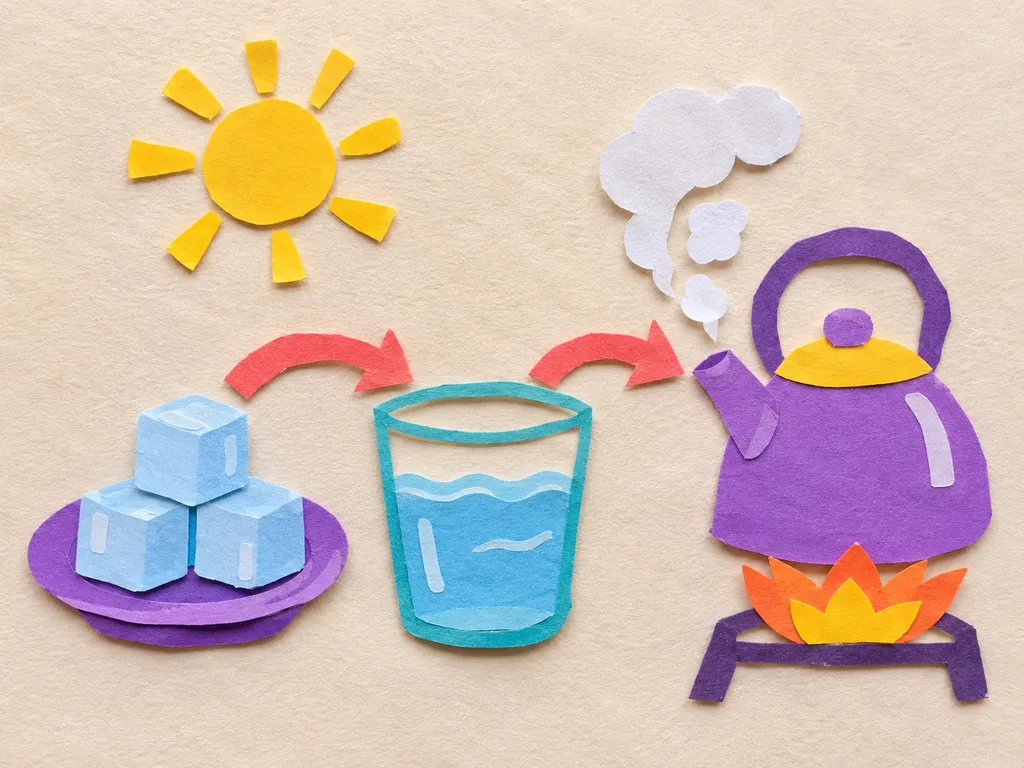
Children may reverse state-change verbs. Ice melts into water; water freezes into ice. Liquid water evaporates into water vapour; water vapour condenses into liquid droplets. Practise both directions together to reinforce the contrast.
Myths and facts
Myth: A liquid has no volume.
Fact: A liquid has a set volume, but its shape changes with the container.
Myth: The white cloud above hot water is a gas.
Fact: Water vapour is invisible; the visible cloud contains tiny liquid droplets.
- Sort six household examples into solid, liquid, and gas categories together.
- Say three complete sentences using precise scientific words for each state.
- Correct one mixed-up label, then explain the scientific reason aloud.
- Read one science book page and underline four states-of-matter words.
- Compare ice and water, then describe each with accurate matter vocabulary.
When a word has several meanings or pronunciations, Cambridge Dictionary is a useful check before turning it into child-friendly examples.
Frequently Asked Questions
Which States of Matter Should My Child Learn First?
Start with solid, liquid, and gas because children can connect them to familiar objects and events. States of Matter in English for Kids: Words and Activities builds confidence with these three terms before adding melting, freezing, evaporation, and condensation. Advanced states such as plasma can wait until your child understands the basic contrasts and wants to explore further.
How Can I Explain Gas When My Child Cannot See It?
Use a balloon, bicycle pump, or empty-looking bottle. Explain that the bottle contains air. Your child can gently squeeze an inflated balloon and feel the gas push back. Say: “Gas takes up space even when we cannot see it.” Avoid experiments involving flames, sealed heated containers, or pressure beyond ordinary household use.
Should My Child Learn the Science or the English Words First?
Teach the idea and language together. Show an ice cube while saying “solid,” pour water while saying “liquid,” and point to an inflated balloon while saying “gas.” This links an object, action, and word in memory. If your child knows the science in another language, invite a brief comparison but keep the target sentence in English.
How Often Should We Practise This Vocabulary?
Practise two or three times across a week for an initial introduction. Each session can last five to ten minutes and reuse the core words in a different setting. One day, sort objects; another day, observe melting; later, compare a solid and a liquid. Review after a gap, then ask your child to explain an example without a model.
Complete three short practice sessions this week:
- Name one solid, one liquid, and one gas.
- Describe one change using melt, freeze, evaporate, or condense.
- Compare two states in one complete English sentence.
Start your child's English journey today — book a trial lesson with LearnLink.
Stay updated on our latest tips and resources by following us on Instagram LearnLink.